
Character.AI alternatives that work in 2026
Written by Clement
The short answer
If you want the closest free replacement, Janitor AI with your own API key. If you want the best conversations and you will tolerate an afternoon of setup, SillyTavern. If you want memory that survives a month of chatting and you will pay for it, Nomi or Kindroid.
- 1.Janitor AI: The default free landing spot. Enormous character library, no filter, and you supply the model through your own API key.
- 2.SillyTavern: Not a service. A local interface you run yourself and point at any model, which is why nothing can filter it.
- 3.Chub AI (Venus): Primarily a character card repository with a usable chat layer on top. Sits between Janitor and SillyTavern.
- 4.Nomi: A paid companion app that treats long-term memory as the product rather than a feature.
- 5.Kindroid: The other paid companion app. Similar memory pitch to Nomi, with a free plan and community-shared personas.
Why everyone started looking in the first place
Two separate things happened, and people conflate them.
The first is the filter, which has been tightening for years and is the reason there is a subreddit called r/CharacterAIrunaways. Character.AI runs a content classifier over both what you write and what the model writes back, and it intervenes mid-scene. For roleplay users that is not a content preference, it is a broken tool.
The second is structural and much newer. On 29 October 2025 Character.AI announced it was removing open-ended chat for under-18 users entirely, and began the removal on 24 November. The rollout stepped down through a two-hour daily cap, then one hour, then nothing. Teen accounts kept Feed, Imagine, AvatarFX and Streams, and lost the back-and-forth conversation that was the entire product. Character.AI also began rolling out age assurance in the US, which means adults get verified too.
So the answer to "what should I use instead" depends on which of those two hit you. A filter problem and an account-eligibility problem have different solutions, and most lists on this query do not make the distinction.
Compared on four axes
| Platform | Price | Filtering | Memory | Setup |
|---|---|---|---|---|
| Janitor AI | Free. Your only cost is the API key, and free tiers exist | None on the platform itself. Your model provider's rules still apply | Weak. This is the single most common complaint | 10 minutes: make an account, paste an API key, pick a character |
| SillyTavern | Free software. You pay whatever your chosen model costs, including nothing | None, structurally. You own the stack | As good as the model you attach and the lorebooks you write | An afternoon. This is the real cost |
| Chub AI (Venus) | Free tier, paid tiers for hosted model access | Permissive. Mature content is expected rather than tolerated | Lorebook system feeds background detail without burning context | Similar to Janitor if you use the built-in chat |
| Nomi | Paid subscription, limited free tier | Adult content permitted; this is a companion app, not a roleplay sandbox | The strongest on this list. It is the entire pitch | Minutes. It is an app |
| Kindroid | Free plan, paid tiers for higher limits and voice | Adult content permitted within the app's own policy | Strong, with explicit long-term memory features | Minutes |
Scroll the table sideways on a phone. Every row links to the full write-up below.
The picks, in detail
Janitor AI
The default free landing spot. Enormous character library, no filter, and you supply the model through your own API key.
Janitor AI is where most people land first, and the reason is the character library rather than the technology. It is one of the largest browser-based collections of community character cards anywhere, which means whatever you were talking to on Character.AI probably has a Janitor equivalent already made.
The model is your problem, and that is the design. You connect an API key and Janitor is the interface. The free routes that work today: OpenRouter's free DeepSeek tier gives you roughly 50 messages a day, and Google's Gemini Flash tiers land somewhere between 50 and 250 depending which model you pick. The built-in JanitorLLM exists but is restrictive enough that most regular users move off it.
Treat it as the on-ramp, not the destination. It is the fastest way to find out whether you want unfiltered roleplay or whether you wanted Character.AI without the interruptions, which are different things.
Where it disappoints
Memory is poor and the character voice drifts toward sexual content fast, whether or not you steered it there. "Every character turns horny after like 4 messages" is a near-verbatim recurring complaint in the alternatives threads. It also does not let you export character cards, so anything you build there stays there.
SillyTavern
Not a service. A local interface you run yourself and point at any model, which is why nothing can filter it.
SillyTavern is the answer the enthusiast subreddits converge on, and it is a different category of thing from the others on this list. It is software you install. It has no models, no accounts and no servers: you connect it to something else, whether that is a paid API, a free tier, or a model running on your own GPU through KoboldCpp.
That architecture is the point. There is no filter because there is no company in the middle to apply one, and there is no shutdown risk because the thing is already on your disk. Memory works better than Janitor's not through magic but because you get lorebooks, author's notes, summarisation and full control of what goes into the context window.
The honest framing from r/SillyTavernAI is that the migration threads are titled things like "the tough decision" and "is it worth moving", and the answers are almost uniformly yes with a caveat about the first evening. If you have ever configured anything, you will be fine.
Where it disappoints
The learning curve is the whole objection. It is a front end with a settings panel that assumes you know what a context window, a sampler and a system prompt are. People who move from Janitor consistently describe the switch as worth it and also describe being lost for the first few hours.
Chub AI (Venus)
Primarily a character card repository with a usable chat layer on top. Sits between Janitor and SillyTavern.
Chub's real value is the lorebook. A lorebook injects relevant background detail into the model's context only when it becomes relevant, instead of stuffing every fact about your world into the character definition and paying for it on every single message. For long-running scenarios that is the difference between a character who remembers your city and one who spends its whole context budget on it.
Its deep card library is the other draw, and it is the one place on this list where the community-authored material is arguably better than the platform.
Where it disappoints
It is a library first and an interface second, and it shows. If what you want is a polished chat app, the card-browsing surface will feel like the main product and the conversation like a feature. Many people use it purely as a source of cards to import into SillyTavern.
Nomi
A paid companion app that treats long-term memory as the product rather than a feature.
Nomi is on this list because a specific complaint keeps recurring in the Character.AI threads that Janitor and SillyTavern do not solve well: people who want the thing they talk to to remember them across months, not scenes.
That is a different product. If you read the migration threads carefully, roughly half of the people leaving Character.AI wanted an unfiltered roleplay tool and half wanted a companion that did not reset. Nomi is squarely aimed at the second group.
Where it disappoints
It is not a roleplay engine and it will disappoint you if that is what you want. Nomi is built around a persistent relationship with a small number of companions, not around loading a thousand community character cards and running scenes. Wrong tool for fan-fiction, right tool for continuity.
Kindroid
The other paid companion app. Similar memory pitch to Nomi, with a free plan and community-shared personas.
Kindroid comes up in the same breath as Nomi in the memory-focused threads, and the two are close enough that the choice usually comes down to which voice and interface you prefer rather than which is more capable.
It has a genuine free plan, which makes it the cheaper of the two to evaluate before committing.
Where it disappoints
The free plan is thin enough that you are really evaluating whether to subscribe, not whether to use it. And like Nomi, it is a companion product: if you want to run a twelve-character fantasy campaign, this is not built for that.
Pick by the problem, not by the ranking
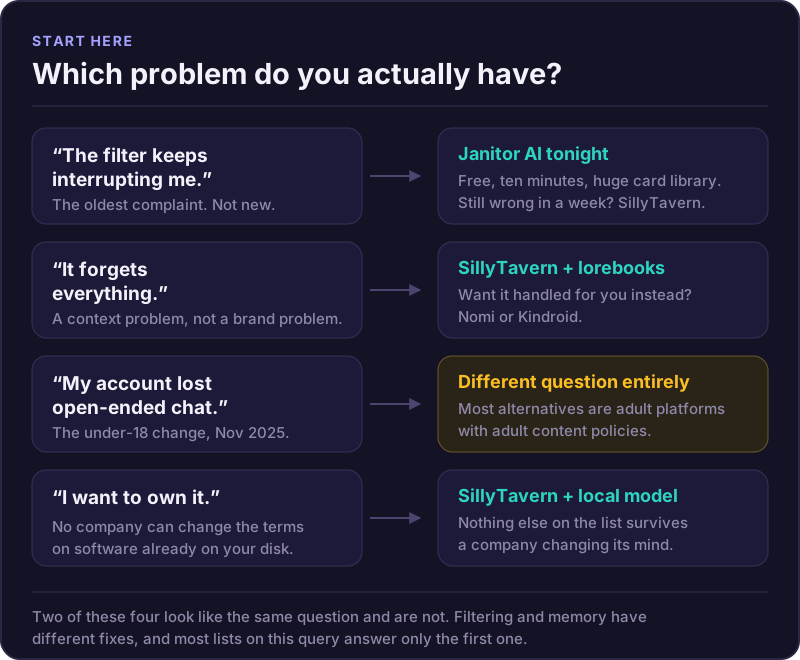
The lists on this query all rank these tools against each other, which is the wrong shape for the decision. They solve different problems and the right pick falls out of which sentence below is yours.
"The filter keeps interrupting me." Janitor AI, tonight. If it still feels wrong in a week, SillyTavern.
"It forgets everything." That is a model and context problem, not a platform problem, and Janitor will not fix it. SillyTavern with lorebooks if you want control, Nomi or Kindroid if you want it handled for you.
"My account lost open-ended chat." If you are under 18, most of this list is not appropriate and the honest answer is that the alternatives are largely adult platforms with adult content policies. That is worth saying plainly rather than routing a fifteen-year-old to an uncensored roleplay site.
"I want to own it." SillyTavern plus a local model. Nothing else on this list survives a company changing its mind.
Frequently asked questions
- Is Character.AI shutting down?
- No. Character.AI removed open-ended chat for under-18 accounts starting 24 November 2025 and is rolling out age assurance, but the platform is running normally for verified adults. If your chats stopped working, the likely cause is the age change rather than a shutdown.
- What is the closest free alternative to Character.AI?
- Janitor AI, by a wide margin, because the character library is close enough in size that most Character.AI bots have an equivalent already made. It is free to use and you connect a free API tier such as OpenRouter's DeepSeek (around 50 messages a day) or Gemini Flash. The trade is memory, which is noticeably worse than Character.AI's.
- Which Character.AI alternative has the best memory?
- For a hands-off app, Nomi and Kindroid both build their product around long-term memory and are the two names that recur whenever someone asks this in the migration subreddits. For control rather than convenience, SillyTavern with lorebooks and summarisation beats all of them, because you decide exactly what stays in context.
- Are these alternatives uncensored?
- Janitor AI, Chub and SillyTavern apply no platform-level content filter, though the model you connect may have its own rules; running a local model through SillyTavern is the only configuration with no external policy at all. Nomi and Kindroid permit adult content within their own published policies, which is not the same as unfiltered. All of them are adult platforms.
- Can I move my Character.AI characters to another platform?
- Not directly, and this bites people. Character.AI has no character export, so a bot you built there has to be rewritten as a character card elsewhere. Janitor AI also does not allow card export, so building there recreates the same lock-in. Chub and SillyTavern use portable character card files, which is a real argument for landing on one of those if you plan to invest time in creating characters.
Keep reading
Get new guides by email
One email when we publish new guides and model breakdowns. No spam, unsubscribe anytime.