
How to Set Up YuE2: A Local, Open-Source AI Music Model
Written by Clement
YuE2 is a 3B open-source music model from M·A·P (Multimodal Art Projection), built around a two-stage idea most music generators skip: it first composes an editable musical score (melody, rhythm, chords, lyrics), then renders that score into a full song with vocals and accompaniment. Because the score is a real intermediate step you can see and edit, you can fix a bad chord progression or rewrite a verse without regenerating the whole track. This walks through running it on a rented cloud GPU via ComfyUI, the same RunPod path used for the local image-model setup.
What makes YuE2 different from a one-shot music generator
Most AI music tools go straight from a text prompt to finished audio: you get a song, and if a section is wrong, your only real fix is regenerating the whole thing with a different prompt and hoping. YuE2 splits the job in two. First it plans a score, an ABC-notation musical structure covering melody, rhythm, chords, and any lyrics, that you can view and hand-edit before anything is rendered to audio. Only then does it decode that score into 48kHz stereo audio with vocals and instrumentation.
That split is what the ComfyUI-FL-YuE2 node pack this setup installs exposes directly: a Piano Roll / Score Editor node you can open, read, and rewrite before the Render Music step ever runs. It's the closest thing to sheet-music-level control this category of model currently offers.
Create a RunPod account
- 1
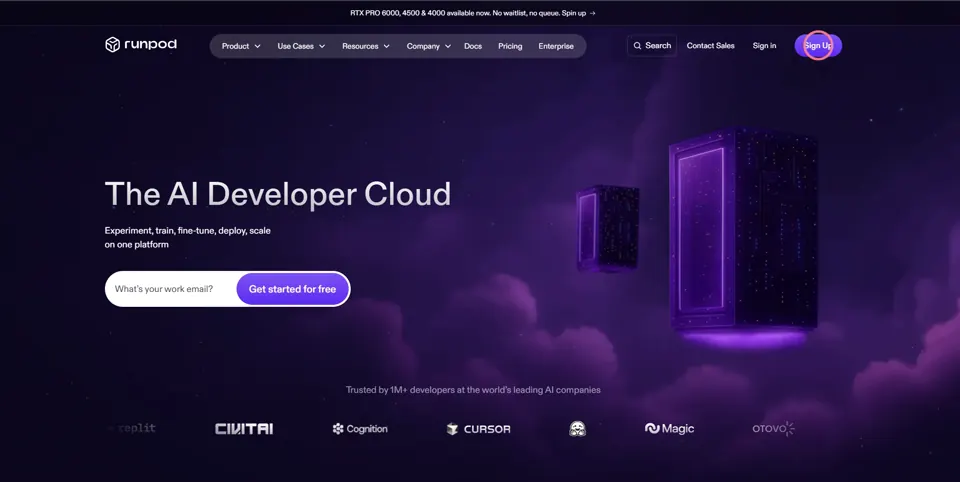
- 2
Add funds to your account
$10 covers a solid testing session. YuE2's checkpoints total under 8GB, so most of your pod time goes to actual song generation, not downloading.
Configure and deploy the pod
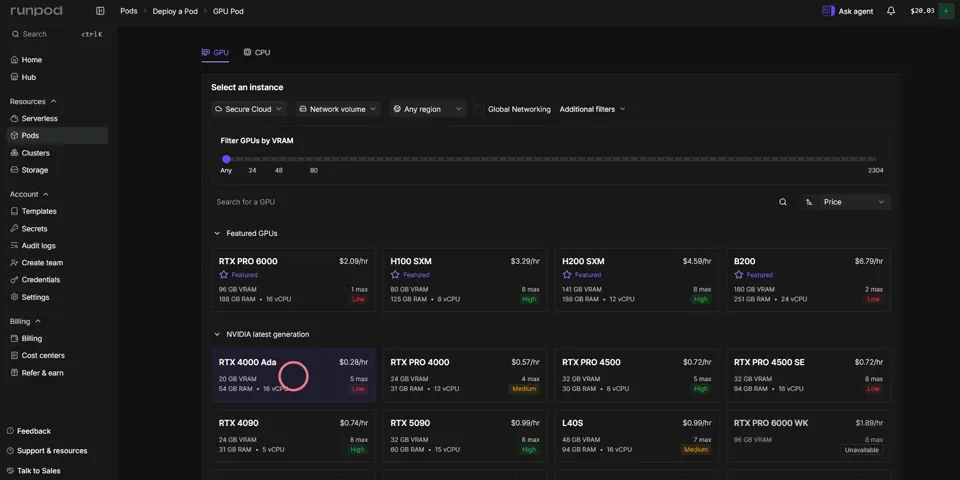
YuE2's upstream README states a 24GB VRAM minimum on a GPU with BF16 support; below that is untested. Pick a card that clears that bar rather than the cheapest one on offer.
- 3
Pick a GPU with 24GB VRAM or more, with BF16 support
From the dashboard, click Pods in the left nav, then Deploy Pod. Sort by VRAM and price, and pick a current-generation card at or above 24GB.
Get new guides by email
One email when we publish new guides and model breakdowns. No spam, unsubscribe anytime.
- 4
Set the pod template to a PyTorch build
Runpod Pytorch 2.8.0 is the current default template; it ships CUDA and PyTorch pre-installed. If a different template is selected, hit Change template and pick it from the list.
- 5
Expose the ports ComfyUI needs
Under Expose HTTP ports, set 8888,4000,8188,8889. 8188 is ComfyUI's default port; the others cover Jupyter and any auxiliary service.
- 6
Set container disk to at least 40GB
YuE2's checkpoints plus ComfyUI and its Python environment fit comfortably in 40GB.
- 7
Deploy On-Demand
On-Demand bills per second of actual usage, no upfront commitment, right for testing before you know how much you'll use this.
Run the setup script in Jupyter
- 8
Open Jupyter Lab
On the pod's Connect tab, port 8888 shows "Jupyter Lab, Ready." Click it.
- 9
Download the setup script
Grab setup_yue2_comfyui.py below and save it locally.
Download the setup script (.py) - 10
Upload the setup script
In Jupyter, upload the file you just downloaded into /workspace.
- 11
Open a terminal and run the script
python setup_yue2_comfyui.py. It clones ComfyUI, installs the ComfyUI-FL-YuE2 custom node, and downloads the YuE2-3B generation model and YuE2-Vae decoder.
Open ComfyUI and load the workflow
- 12
Go back to the pod's Connect tab in RunPod
Same screen you used to open Jupyter.
- 13
Open port 8188
That's ComfyUI's default port, already exposed from the pod-template step above. Click it once the setup script finishes.
- 14
Close the pop-ups
ComfyUI opens with a couple of dialogs on top. Close them to get to the empty canvas.
- 15
Download the workflow file
Grab the .json workflow below. It's ComfyUI-FL-YuE2's own official score-editor example: a pre-filled ABC score and style/lyrics prompt feeding Compose, then Render Music, then Decode Audio.
Download the workflow file (.json) - 16
Drag and drop the file onto the canvas
The full node graph appears: Load Models feeding a Piano Roll / Score Editor and Compose node, into Render Music, then Decode Audio, then Preview and Save Audio.
Install missing nodes and generate your first track
- 17
Click the Manager button, then Install Missing Custom Nodes
The workflow references the ComfyUI-FL-YuE2 node pack your fresh install doesn't have registered in Manager yet; this lists it.
- 18
Select all, install, then restart ComfyUI
Click the install button, wait for it to finish, then click the red Restart button and confirm. Reload the browser when prompted.
- 19
Set download_missing to true on the Load Models node
This lets the node pack fetch any remaining model file it needs directly into ComfyUI/models/yue2/ the first time you queue.
- 20
Edit the style prompt and lyrics, then Execute
In the Compose node, replace the sample style description and lyrics with your own. Leave the Score Editor's ABC field as-is for an instrumental first test, or write your own melody/chords in ABC notation. Click Execute, top right.
Hardware and software checklist
This mirrors YuE2's own upstream requirements; the ComfyUI node pack adds no further hardware constraint of its own.
| GPU | 24GB VRAM minimum, with BF16 support, per the upstream README (below that is untested) |
|---|---|
| Container disk | 40GB or more |
| License | Source/nodes: Apache 2.0. Model weights (YuE2-3B, YuE2-Vae): CC BY-NC 4.0, non-commercial only |
Troubleshooting
| Out-of-memory error | Lower max_score_tokens or max_duration on the Compose/Render nodes, or move to a GPU above the 24GB minimum |
|---|---|
| Generated song ignores the lyrics | Check the lyrics field is wired into Compose, and that the style prompt doesn't contradict having vocals (e.g. "no singing" phrasing left over from an instrumental test) |
| Score Editor shows an empty or malformed ABC block | Re-run Compose; a from-scratch composition occasionally needs a reroll, same as any generative step |
| Missing custom node after loading the workflow | Run Manager's Install Missing Custom Nodes again and confirm ComfyUI-FL-YuE2 finished cloning before retrying |
Frequently asked questions
- What is YuE2, and who made it?
- YuE2 is a 3B open-source music model from M·A·P (Multimodal Art Projection), with academic and industry collaborators including HKUST, NYU, Stanford, and MBZUAI. It composes an editable musical score before rendering a full song with vocals and accompaniment from it.
- Do I need a GPU to run YuE2 locally?
- Yes. YuE2's own README states a 24GB VRAM minimum on a GPU with BF16 support; running through ComfyUI on RunPod doesn't lower that requirement.
- Can I use YuE2's output commercially?
- No, not under the setup in this guide. YuE2's source and ComfyUI nodes are Apache 2.0, but the model weights (YuE2-3B, YuE2-Vae) are CC BY-NC 4.0, non-commercial use only. Check the license yourself before using generated output commercially.
- What does "editable score" actually mean in practice?
- Before YuE2 renders any audio, it produces a musical score in ABC notation, melody, rhythm, chords, and lyrics, that the ComfyUI-FL-YuE2 node pack lets you open, read, and hand-edit. You can fix a chord or rewrite a lyric line before the audio render step, instead of only being able to reroll the whole generation.
- Is running YuE2 on RunPod free?
- No, RunPod bills per second for GPU time, and YuE2's 24GB VRAM requirement means a somewhat higher hourly rate than a smaller model. YuE2's checkpoints are small (under 8GB total), so download time isn't the cost driver, the GPU rental during generation is.
- How is this different from using Suno?
- Suno is a hosted service with its own pricing and content policy; see the Suno cost guide for what that runs. YuE2 runs entirely on hardware you control, with an editable score you can hand-tune before rendering, at the cost of the RunPod setup here, the GPU rental while it runs, and a non-commercial license on the weights.
Keep reading
How to Set Up AuK: A Local, Uncensored Voice Model
Install AuK, Tencent's open-source 1.5B speech model, on a rented RunPod GPU through ComfyUI: zero-shot voice cloning, text-to-speech, and speech editing with no account, no content filter, and no per-second usage fee once it's running.
How much does Suno AI cost?
What Suno AI costs: how its credit system works, the real difference between the free, Pro, and Premier tiers, the commercial-use catch on the free plan, what a single song costs, and how to pick the right tier.

How to Set Up a Local NSFW Image Model: Full Tutorial
Install an adult image-generation workflow on a rented cloud GPU: RunPod, ComfyUI, a real workflow file, and every step in between, screenshot by screenshot.

How to Make AI Porn: The Full Pipeline, Idea to Finished Video
The real production method behind a finished AI adult video: script first, repeatable character and scene sheets, then generation, then stitching it all into one clip with one consistent voice.
Get new guides by email
One email when we publish new guides and model breakdowns. No spam, unsubscribe anytime.